
For Admins
Groups & Communities 👥
Groups split one community into departments, teams or squads. Each group has its own scheduler, and the community's settings apply to all of them. If a team needs its own event types, colors or reminders, give it a separate community.
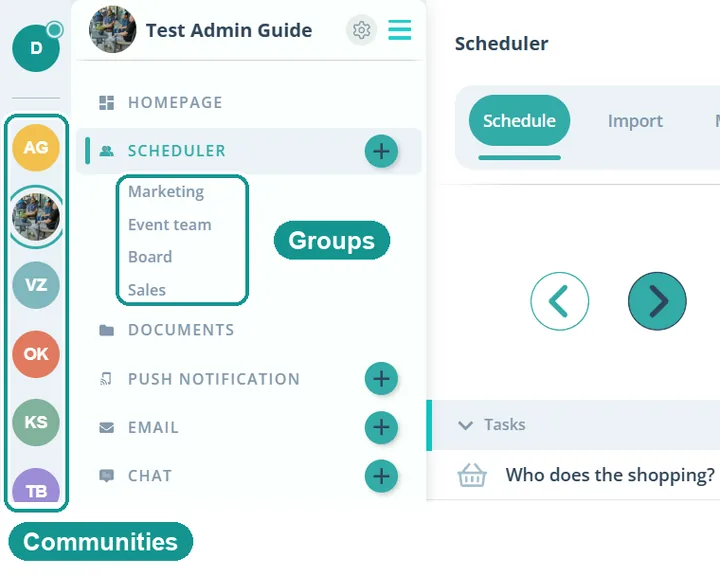
Your communities sit on the far left of the bar. You find the groups of the open community in the menu under Scheduler.
Group or separate community?
- Groups in one community you set event types, response options, tasks and notifications once, and they apply to every group. A group's events are visible to its invited members and to all admins in the group scheduler.
- Separate communities each one has its own event types and colors, its own response options and its own event reminders. That way every lead sets up their community the way they work.
- Rule of thumb if everyone follows the same processes, groups are enough. If each lead wants their own rules, use separate communities.
Tasks or groups?
- Group a fixed team with its own group scheduler. The group's events go to its members.
- Task a role at an event, e.g. cash desk, setup or teardown. Anyone invited signs themselves up, one event at a time.
- Rule of thumb fixed teams as a group, changing roles per event as a task.
Example: The organizing team meets every month, so it becomes a group. At the event, you need people for setup, cash desk and teardown. Those are tasks.
Anyone in several groups shows up under each group in the Scheduler. Their response still counts only once. More: Create Tasks 📋
What do admins use groups for?
- Companies marketing, sales and the event team each plan in their own group scheduler. Management is admin and sees every group scheduler.
- Organizations project teams, committees and volunteer teams each get a group.
- Clubs the board, teams, sections or helper crews each have a group.
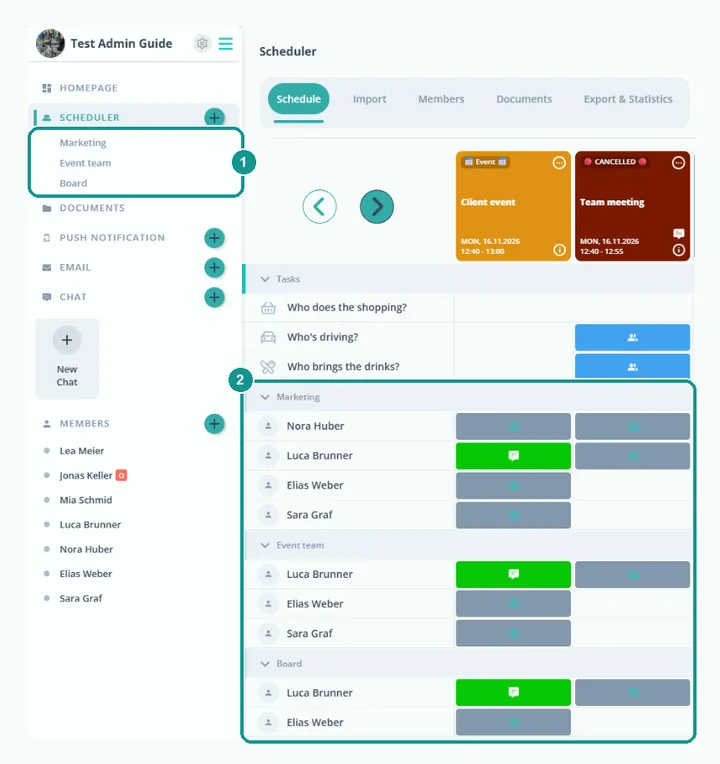
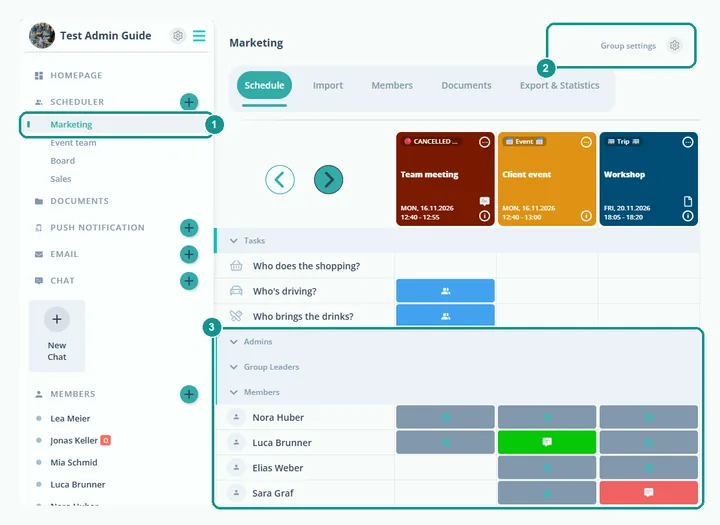
In the Scheduler you see every group on the left (1). The plan lists members sorted by group (2). Anyone who isn't in a group appears under Without group.
How do I create a group?
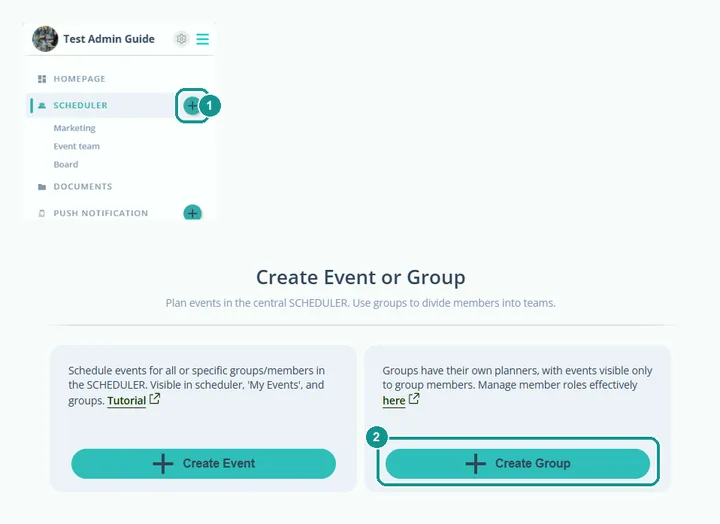
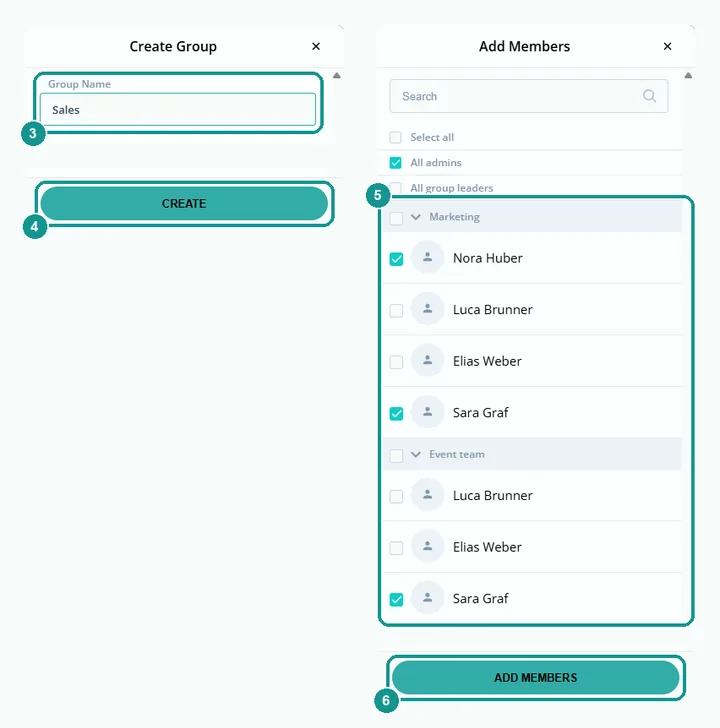
- In the left sidebar, click ➕ next to Scheduler (1).
- Choose Create Group (2).
- Enter the Group Name (3) and click Create (4).
- Select the members (5) and click Add Members (6).
The group appears on the left below the Scheduler (1). Under Group settings (2) you rename or delete the group. The group scheduler shows admins, group leaders and members (3). Events you create here are visible to the invited members of this group and all admins.
How do I add members to a group later?
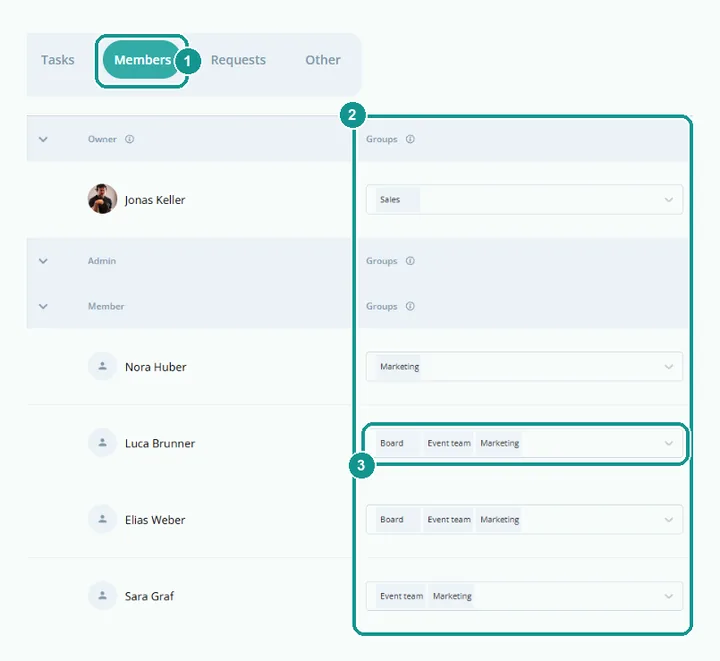
Click the gear ⚙️ next to your community's name and open the Members tab (1). In the Groups column (2), pick one or more groups next to a person or remove them again (3). This also works for new members right when you add them.
Where do admins see a group's events?
In the group scheduler. Admins can open any group on the left, even if they aren't a member, and see all of its events there. The community's Scheduler only lists events created there. Under My Appointments, group events only show up if you're in the group and were invited.
How do I move members between communities?
With the Member Matrix 👤🔀: under My communities > Matrix, check a box per person and community. Gumb saves instantly.
Can someone be an admin in several communities?
Yes. A person can be an admin in as many communities as you like and then has access to all of them. In a company, for example, management is admin in every community, while each department lead only manages their own. The owner has access everywhere anyway.
What do members in several groups or communities see?
All events in one place. A member can be in several groups and communities. Under My Appointments they see all events in chronological order, no matter which group or community they come from. In the iOS and Android app, My Appointments is the home screen. Clicking an event opens the scheduler of that community.
Which plan fits your setup?
Pro includes one community with a shared main scheduler, up to 100 members and up to 20 group schedulers. That's enough for many smaller companies, organizations and clubs: you work with shared settings and split teams or departments into groups.
Premium is for companies with several departments or locations and for clubs with several teams that each need their own settings. Premium comes with 2 to 30 communities. Each one has its own main scheduler, and every community adds 100 members and 20 group schedulers.
Every plan includes every feature. You'll find the prices on the pricing page.
How do I create another community?
Click ➕ at the far left of the sidebar and enter a name and category. The Admin Guide 🚩 shows the steps. Pro includes one community, for more you switch to Premium: Which Plan Fits? 💼